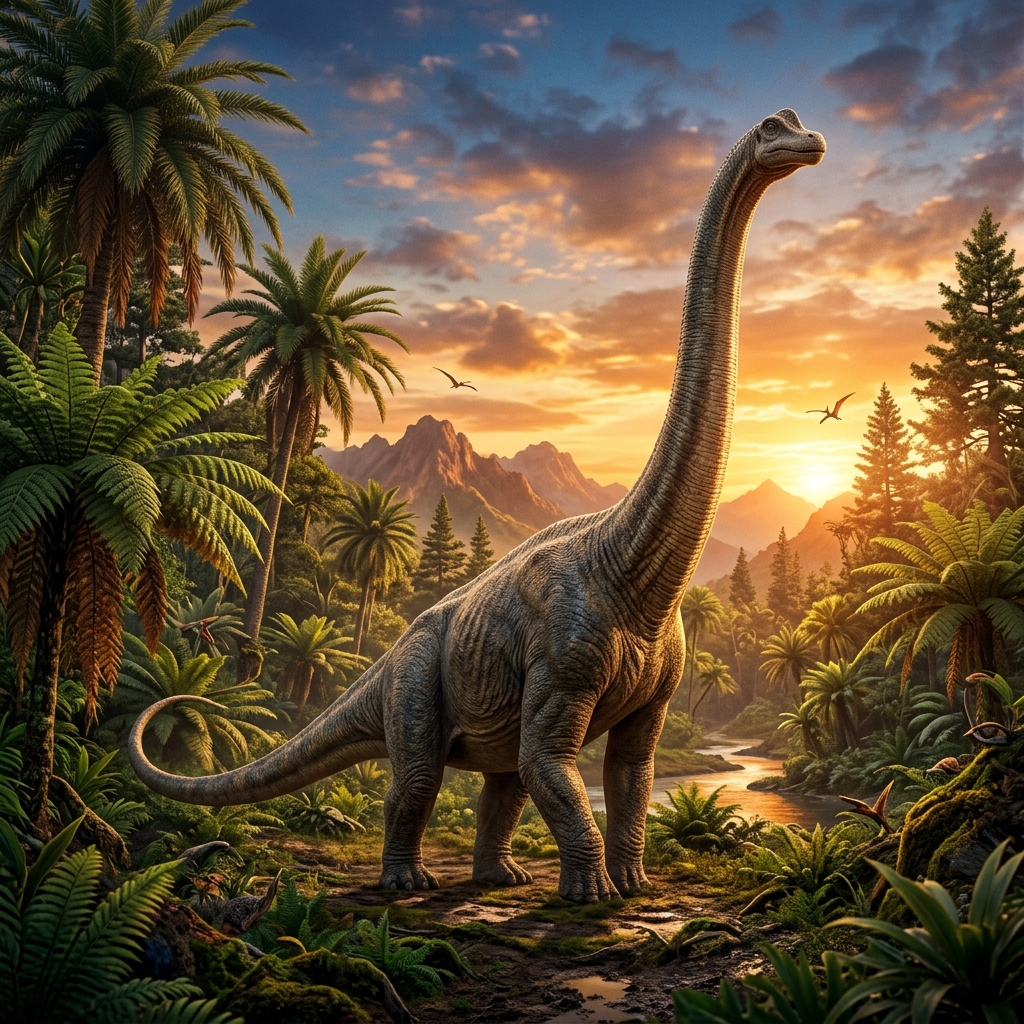
Late Jurassic · 156–145 Million Years Ago
The Brontosaurus "Thunder Lizard"
The mightiest gentle giant to ever walk the Earth.
A sauropod legend — enormous, graceful, and awe-inspiring.
Late Jurassic · 156–145 Million Years Ago
The mightiest gentle giant to ever walk the Earth.
A sauropod legend — enormous, graceful, and awe-inspiring.
Brontosaurus was one of the largest animals ever to walk the Earth — a massive sauropod dinosaur that lived approximately 156 to 145 million years ago during the Late Jurassic period.
Despite its enormous body — stretching up to 22 meters long — the Brontosaurus was a peaceful plant-eater. It used its incredibly long neck to reach leaves high in the treetops that no other land animal could access.
For over a century, Brontosaurus was considered invalid as a genus, mistakenly merged with Apatosaurus. But in 2015, a landmark study confirmed it as a truly distinct and unique species — restoring its legendary name!
Hover over each panel to reveal details
Click any hotspot to learn about that body part
Click a glowing hotspot
on the diagram to learn
about that body part!
As the Jurassic sun rises over the fern-covered plains, the herd slowly stirs. Brontosaurus starts its day slowly, warming in the early light before beginning its endless search for food.
Hours are spent sweeping that magnificent neck through the treetops and undergrowth, stripping leaves, ferns, and soft vegetation. An adult needs up to 400 kg of plant matter every single day!
The herd migrates to a nearby river or lake. Despite its incredible size, Brontosaurus was likely a good swimmer — its hollow bones and barrel body provided natural buoyancy.
Back to foraging. With a brain the size of a lime, most of the Brontosaurus's mental energy went toward finding food and staying with the herd. Safety in numbers kept predators at bay.
As the twin moons of prehistoric skies rise, the herd settles. Some scientists believe Brontosaurus slept standing up like modern horses, conserving energy for another day of being magnificent.
Brontosaurus was "extinct" as a name for 112 years!
tap to reveal ↩Scientists incorrectly merged it with Apatosaurus in 1903. A 2015 study with 477 physical measurements proved it was always its own unique species. The name lives again!
Its tail could break the sound barrier!
tap to reveal ↩Scientists estimate Brontosaurus could crack its whip-like tail at speeds exceeding 1,200 km/h — creating a sonic boom! Possibly used to startle predators or communicate.
Its bones were hollow to support its weight!
tap to reveal ↩Like modern birds, Brontosaurus had air sacs running through its vertebrae — called pneumatized bones. This made the skeleton lighter and allowed the animal to grow so massively.
Its heart was the size of a car!
tap to reveal ↩To pump blood all the way up that 9-meter neck, scientists estimate Brontosaurus had a heart weighing up to 400 kg and generating immense blood pressure to reach the brain!
Eggs were left alone after laying!
tap to reveal ↩Unlike some dinosaurs, giant sauropods like Brontosaurus likely laid eggs and moved on. The eggs were buried in warm soil, and hatchlings were completely on their own from day one.
Brontosaurus is the most famous dinosaur in pop culture!
tap to reveal ↩From The Flintstones (Dino!) to Night at the Museum and countless logos and cartoons, Brontosaurus has appeared in more films and shows than any other dinosaur species.
How well do you know the Thunder Lizard?